What Happens When Force Shifts Forward
Lesson 22 · Structural Decision Framework
In plain English
We see this all the time: a patient comes in for a chipped upper front tooth. They thought they bit something hard. "Almond? Maybe an apple seed? I really don't know."
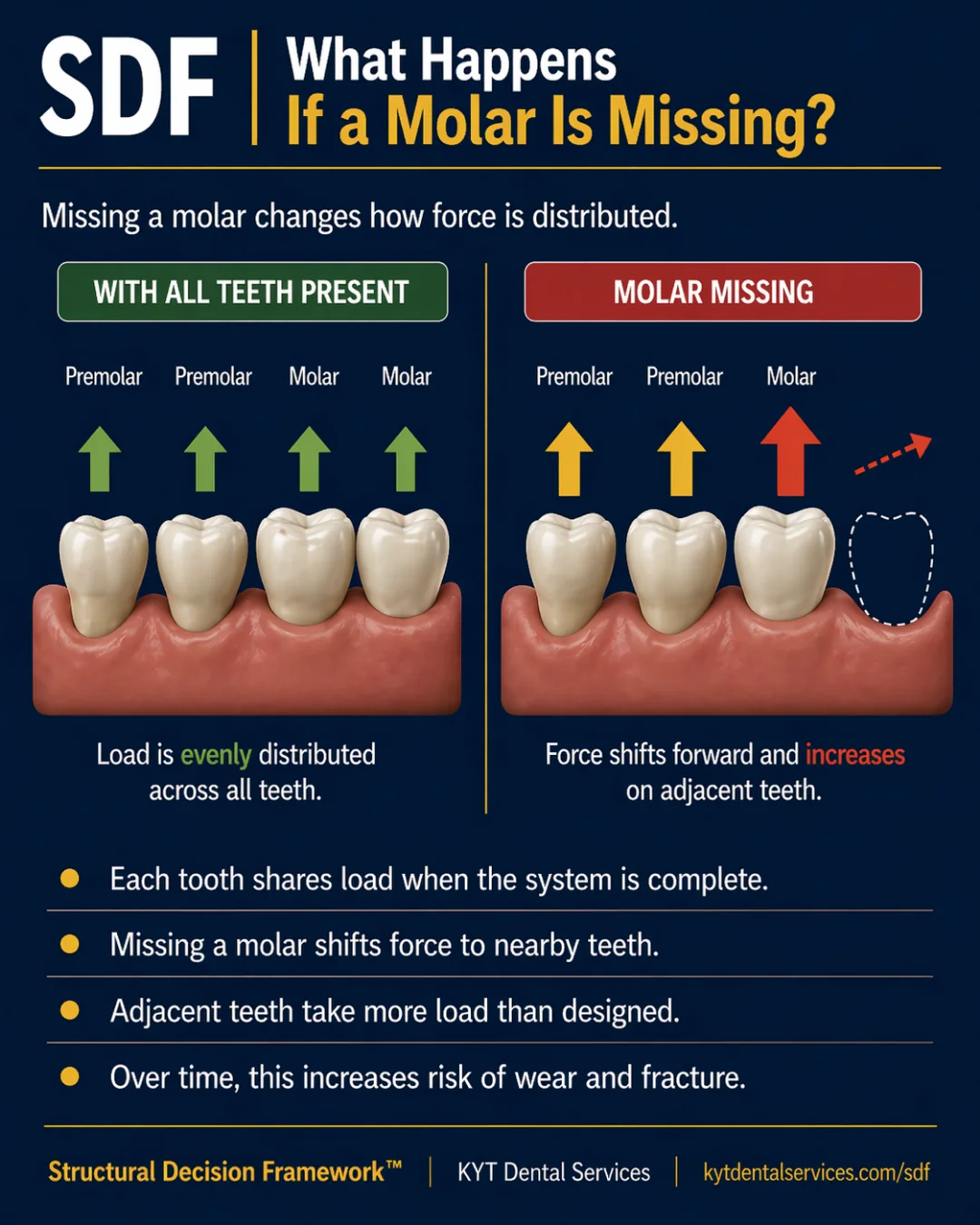
The exam shows a missing lower second molar, extracted years ago, never replaced. Wear patterns on the front teeth that say they've been doing molar work. The chip wasn't random. The front tooth was losing a fight with a force load it was never designed to handle.
Restoring the chip is part of the answer. Restoring the back-tooth load distribution is the rest of it.
Here's the part most patients don't realize:
When back teeth are missing or weakened, the force they used to absorb doesn't disappear. It moves forward, onto teeth built for cutting, not crushing.
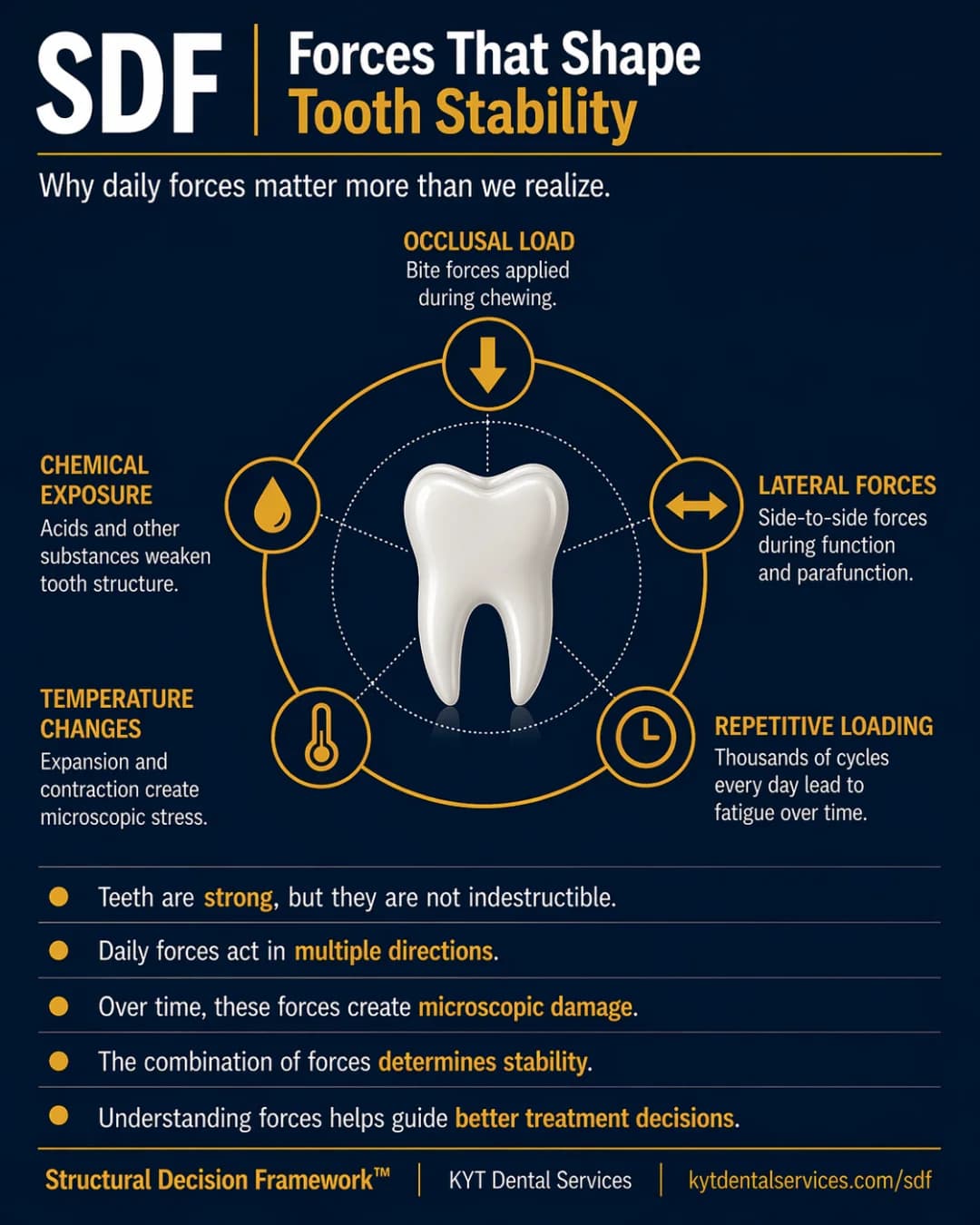
A balanced bite has most of the chewing force absorbed in the back, where the teeth are designed for it. When that's compromised, by a missing molar, a weakened back tooth, a high-force restoration that's failing, the bite shifts. Front teeth, which were designed to cut and tear, end up doing work they were never built for.
The consequences are predictable:
• Chipped and cracked front teeth. They weren't built for grinding loads. When they take them, they damage faster.
• Stress on gums and supporting bone. The periodontal tissues around front teeth weren't designed for heavy compressive force.
• Bite changes that strain the jaw joint. As the front teeth shift to handle the new load, the joint compensates, and TMJ symptoms often follow.
• More complex and costly future treatment. Each cycle of forward-shifted force makes the next round of dentistry bigger.
This is why "just one missing molar" is rarely just one missing tooth. The damage doesn't stay where it started. It spreads, to the front teeth, the gums, the joint, and eventually the whole bite.
Protect back teeth. Replace them when they're lost. Restore them well when they're compromised. Keep force where the system was designed to absorb it.
The Lesson
One idea. One lesson.
Every idea in the Structural Decision Framework gets its own lesson. Hover to feel the foil.
SDF-22
ForceWhat Happens When Force Shifts Forward
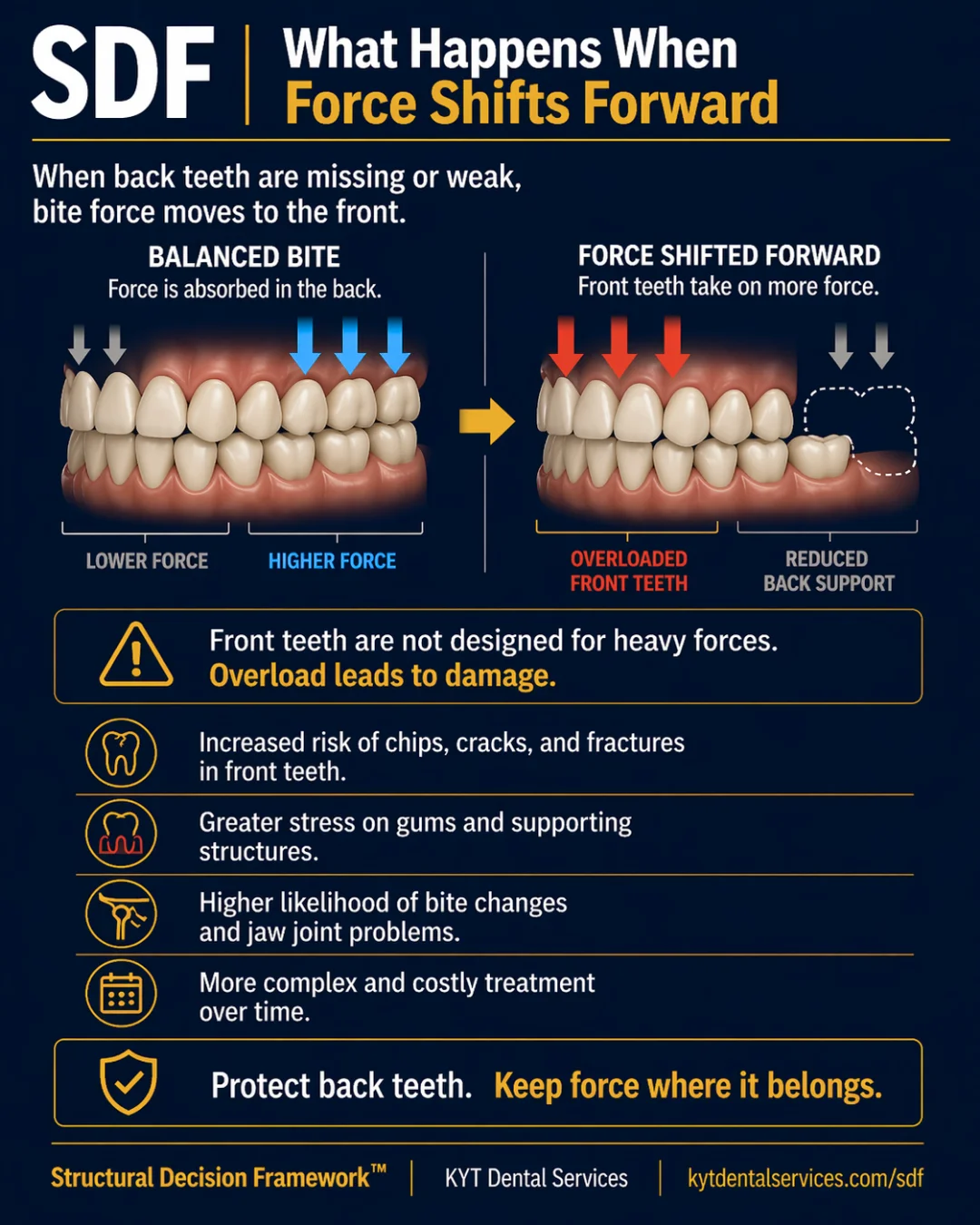
When back teeth are missing or weakened, the bite force they used to absorb has to go somewhere, and it moves forward, onto teeth that weren't built for it. Front teeth chip, gums get stressed, the jaw joint changes, and the cost of the next round of treatment goes up.
↓ Open the model
Inside the Model
Read the diagram.
Through the Force lens, the mouth is a load distribution system, and the back teeth are the part designed to carry most of the load. What Happens When Force Shifts Forward is the card that shows what goes wrong when that system is broken. The damage doesn't stay in one place, it spreads, predictably, to the teeth, gums, and joints downstream of the original loss.
Fig. 22 · What Happens When Force Shifts Forward
SDF Framework
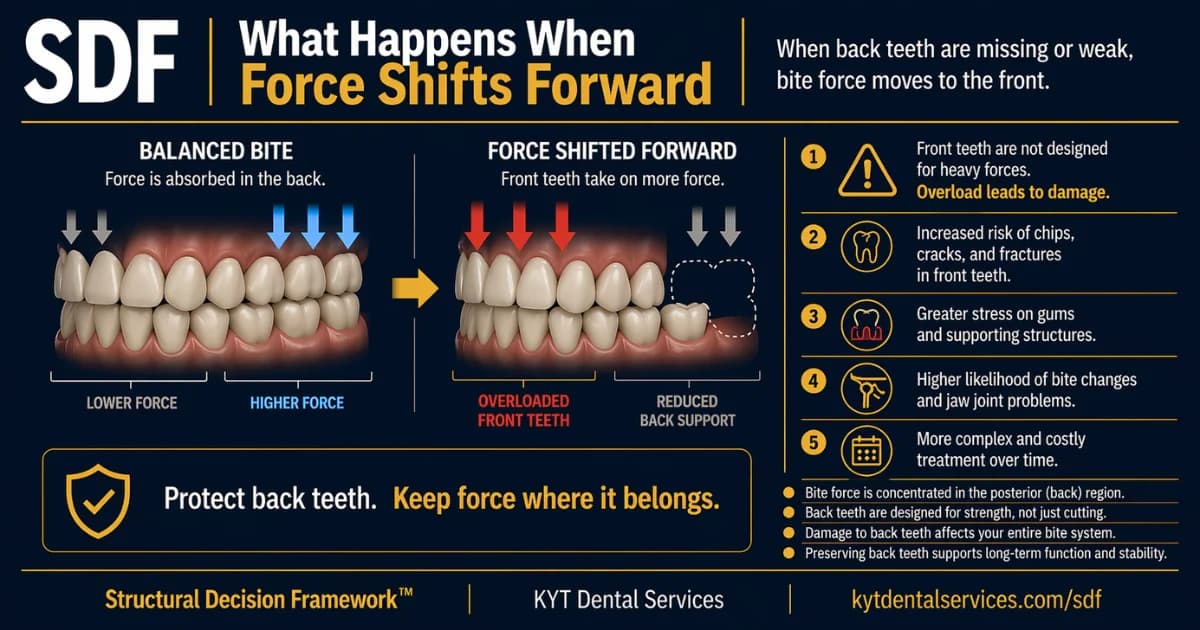
Bite force has to go somewhere. When back teeth do their job, force is absorbed where it belongs, in the part of the mouth designed for it. When back teeth are missing, weakened, or failing, that same force moves forward, onto teeth built for cutting, not crushing. The result is predictable: front teeth chip and crack, gums and supporting bone take more stress, the jaw joint can start to change, and the next round of treatment is bigger than the one before. Protecting back teeth is what keeps the load distribution intact.
Explanation
Your bite is a system. When all the load-bearing parts are working, the force from chewing distributes the way the system was designed for, most of it in the back, where the molars and premolars are built for compressive load. When part of that system is compromised, a missing first molar, a weakened second molar with a large failing filling, a back tooth with a fractured cusp the patient is avoiding, the force doesn't go away. It redirects. The most common direction is forward. Front teeth, which were built to cut and tear, end up doing the work that molars used to do. Because they weren't designed for it, they show the strain quickly: incisal chips, hairline cracks, increased mobility, accelerated wear on the edges. The gums and bone supporting the front teeth are also under more stress than they were built for, which can show up as recession or pocketing. The bite itself starts to change as the front teeth shift to accommodate the new load, and that bite change can pull on the jaw joint, producing the kind of asymmetric stress that's often the start of TMJ symptoms. None of this happens overnight. It happens slowly, and each year the imbalance runs makes the next round of treatment bigger. Protecting back teeth, restoring them well, replacing them when lost, monitoring them more aggressively because they take more force, is structural protection for the entire mouth.
Key takeaways
- Force from a missing or weakened back tooth doesn't disappear, it redistributes forward.
- Front teeth are designed for cutting, not crushing, so they damage faster under heavy load.
- The gums, supporting bone, and jaw joint all take additional stress when force shifts forward.
- Each cycle of forward-shifted force makes the next round of treatment more complex and expensive.
- Protecting and restoring back teeth keeps force where the system was designed to absorb it.
In the chair
How it shows up.
01
The chipped front tooth that was really a back-tooth problem
A patient comes in for a chipped upper incisor. They thought they bit something hard. The exam shows a missing lower second molar from years ago, and wear patterns on the front teeth that say they've been doing molar work. The chip wasn't random; it was the front tooth losing a fight with a force load it was never designed to handle. Restoring the chip is part of the answer. Restoring the back-tooth load distribution is the rest of it.
02
The TMJ problem with a structural cause
A patient develops jaw soreness and a clicking joint over a year. They've also been chewing only on one side, because a back tooth on the other side has a failing crown and is sensitive. The asymmetric force has changed how the jaw moves, and the joint is showing the strain. Treatment isn't just for the joint, it's restoring the back tooth so the patient stops compensating in a way that the joint is paying for.
03
The cascade caught early
A patient lost a back tooth and replaced it with an implant within a year. Five years later, none of the cascade has happened, no front-tooth chips, no bite shift, no joint symptoms. The implant did what the original tooth did: absorbed force where the system was designed to absorb it. That's what 'protect back teeth' looks like at the system level.
Through other lenses
The same idea, three other ways.
The card is about where force goes when the system that was supposed to absorb it is broken. Force doesn't disappear; it redirects. Reading the redirection is what predicts the next failure.
Front teeth absorbing back-tooth force lose structure faster than they should, chips, cracks, edge wear all show up earlier than they would have. The structural cost of a missing back tooth gets paid by the front teeth, year after year.
Stability of the entire bite depends on the load distribution staying close to what the system was designed for. Once force shifts forward significantly, the bite is in a new equilibrium, and the new equilibrium degrades faster than the original one.
Common questions
FAQ.
Why can't my front teeth handle more force?+
Because they weren't built for it. Front teeth are pointed and thin, with single roots, designed for cutting and tearing. Back teeth are broad and flat, with multiple roots, designed for grinding under compressive force. When front teeth take on grinding load, they damage faster, chips, cracks, edge wear, because the geometry isn't right for the job.
How do I know if force has shifted forward in my bite?+
Some clues: chipping or wearing on the front teeth without an obvious cause, chewing predominantly on one side, soreness in the jaw or jaw joint, increased sensitivity in the front teeth, or recent restorations on front teeth that didn't have problems before. None of those are conclusive on their own, but together they often point to a back-tooth problem driving front-tooth symptoms.
If I'm missing a back tooth, do I really need to replace it?+
Often yes, but the answer depends on which tooth, how the rest of the bite is responding, and the time horizon. The decision isn't only 'fill the gap.' It's whether the load that used to go through that tooth is being absorbed safely elsewhere. If front teeth, gums, or the jaw joint are showing strain, replacement is structural maintenance for the whole system.
What if the back tooth isn't missing, just weakened?+
Same principle. A weakened back tooth, large failing filling, cracked cusp, deep decay, is partially out of the load distribution. The patient often unconsciously avoids chewing on it, which shifts force to other teeth. Restoring the back tooth (often with a crown) puts it back in the system. The cost of the restoration is usually less than the cost of letting the cascade run.
Is the cascade reversible once it's started?+
Partially. Restoring the back-tooth load distribution often stops further damage and lets the front teeth, gums, and joint recover. But structure that's already been lost (chipped enamel, gum recession, joint changes) doesn't fully reset. The earlier the imbalance is corrected, the less of the cascade has to be undone.
See this lesson in a real case
Stories behind this lesson.
Patient cases where this idea showed up in the chair.
See it in real teeth
From idea to actual cases.
This site explains the idea. The clinical version, with real cases, real X-rays, and what this looks like in actual mouths, lives at KYT Dental Services, the practice this framework comes from.
See it on KYT Dental Services →Keep going