Crack Progression Under Load
Lesson 18 · Structural Decision Framework
In plain English
We see this all the time: a patient mentions "my back tooth feels weird sometimes when I bite down", no constant pain, no hot or cold sensitivity, just an off feeling on certain bites.
We shine a strong light through the tooth (transillumination). A hairline crack lights up across one cusp. It's not visible on X-ray. It's not visible to the eye. But it's there, and the way it scatters the light tells us it's been propagating for a while.
If we treat now, the tooth keeps its nerve and probably lasts decades. If we wait six months, that same crack might reach the pulp, and "crown" becomes "root canal plus crown." Same crack. Two stages apart. Two completely different procedures.
Here's the part most patients don't realize:
Cracks don't appear, they grow. And they grow through five stages:
1. Initiation: a microscopic flaw forms. Often invisible.
2. Propagation: the flaw begins to extend with each bite. Slow. Silent.
3. Growth: the crack deepens. Light starts to scatter through it, detectable now.
4. Acceleration: past a threshold, the crack tip concentrates stress on itself, so each load extends it more. The slope steepens.
5. Failure risk: normal chewing can split the tooth.
The first three stages are slow and usually silent. The last two are fast. Most cracks are caught by accident, at a routine cleaning, by transillumination, or when the patient mentions a vague "weird feeling" that turns out to be something. Catching one in stage 1, 2, or 3 is what keeps it from reaching stage 4 or 5.
This is why "my tooth feels weird sometimes" is worth saying out loud. It's also why we look for cracks even when patients have no symptoms, because the catch in stage 2 is what saves the nerve.
The Lesson
One idea. One lesson.
Every idea in the Structural Decision Framework gets its own lesson. Hover to feel the foil.
SDF-18
ForceCrack Progression Under Load
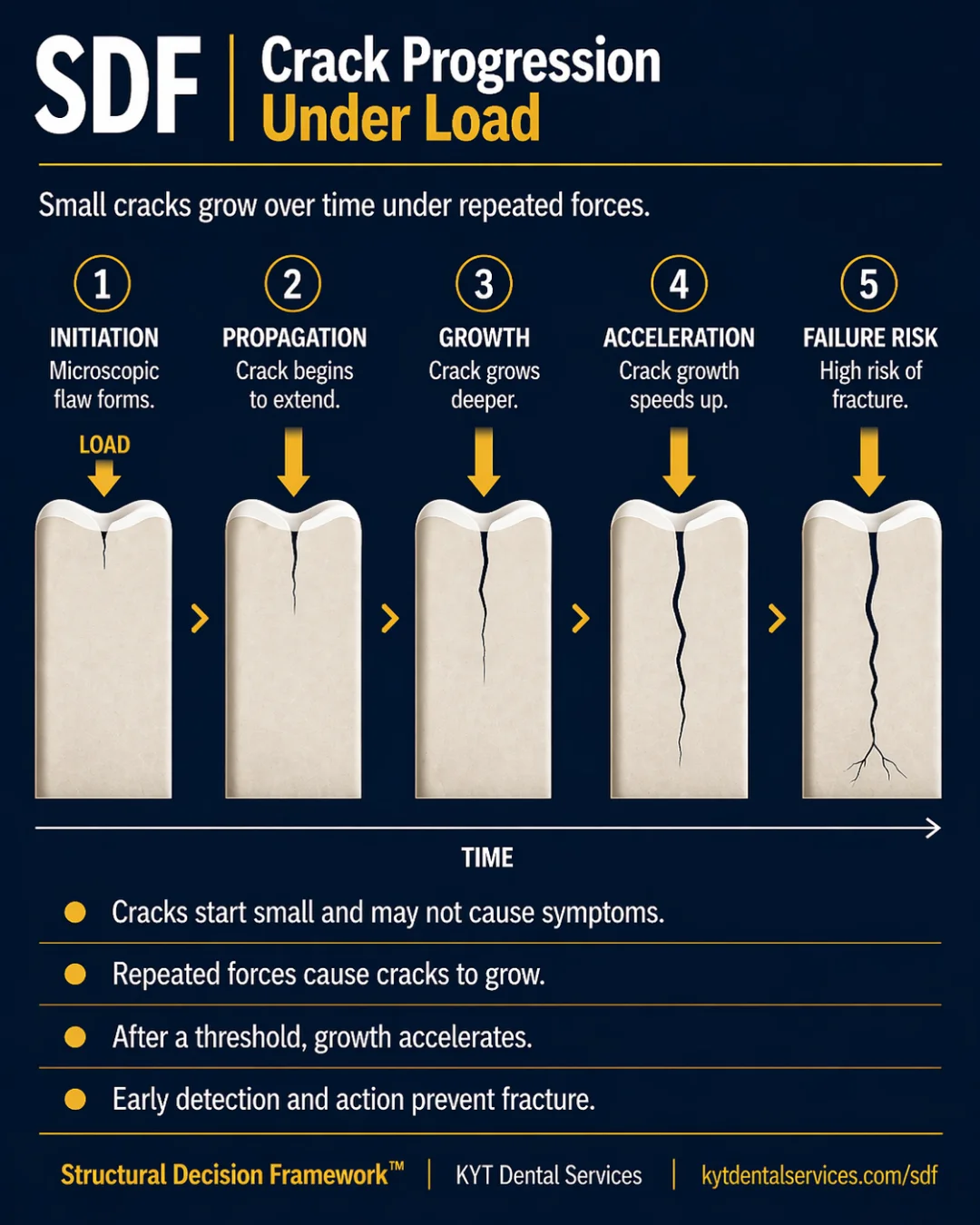
Cracks don't grow at a steady rate. They start microscopic and silent, slowly extend under repeated forces, and past a threshold they accelerate fast. Catching one in the early phase is what keeps it from reaching the late one.
↓ Open the model
Inside the Model
Read the diagram.
Through the Force lens, cracks are the visible record of how a tooth has been loaded across its life. Crack Progression Under Load is the card that shows the whole curve: a flaw forms, repeated forces extend it, a threshold is crossed, growth accelerates, and the tooth reaches failure risk. Each stage has a different right answer, and the difference between them is what makes timing in dentistry such a leverage point.
Fig. 18 · Crack Progression Under Load
SDF Framework
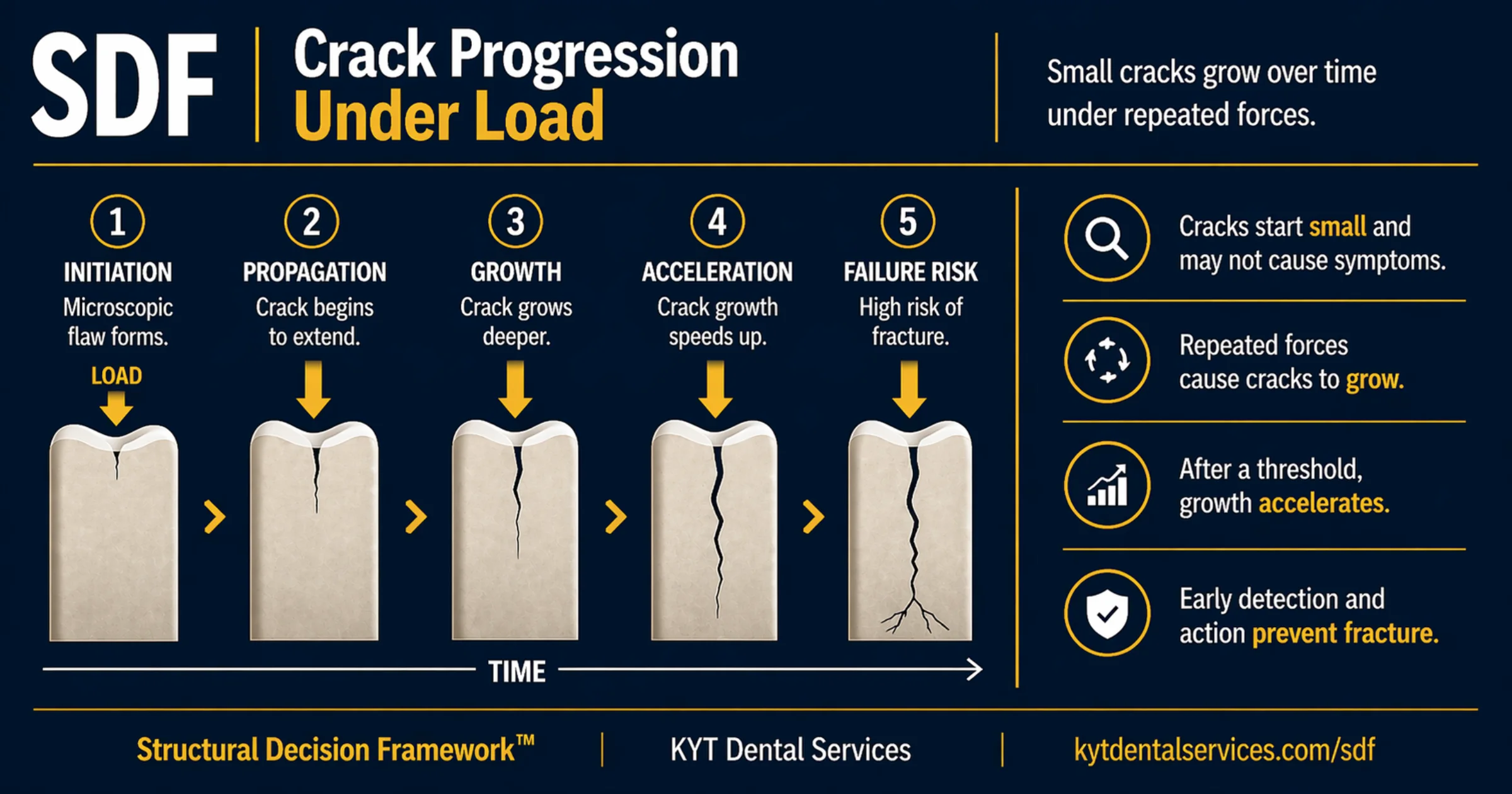
Cracks in teeth grow through five stages: initiation (a microscopic flaw forms), propagation (the flaw begins to extend), growth (it deepens), acceleration (growth speeds up past a threshold), and failure risk (the tooth is at high risk of fracture). The first three stages are slow and usually silent. The last two are fast. The whole point of monitoring teeth, and protecting them from excessive force, is to keep cracks in the slow phase, where the response is small.
Explanation
Every crack starts as something microscopic. A small flaw in the enamel, a stress point at the edge of an old filling, a place where one cusp meets the next under heavy load. On its own, that flaw doesn't do anything. What turns it into a problem is repetition. Chewing, grinding, and clenching apply load thousands of times a day. Each load extends the crack by a tiny amount, far too small to feel or see. For years, this is the slow phase: the crack is propagating and growing, but slowly enough that the tooth still does its job. Past a threshold, two things change at once. The crack has reached a depth where the remaining structure can't absorb the same forces, so each load does more damage. And the crack tip itself concentrates stress, so the same load extends the crack further than it used to. The slope steepens. What took ten years to develop can finish in months. By failure risk, the fifth stage, normal chewing can split the tooth. The card is about reading where on this curve a tooth is, and acting while there's still curve left to control.
Key takeaways
- Cracks start as microscopic flaws, too small to see or feel.
- Repeated chewing and grinding forces extend cracks a little at a time.
- The first three stages (initiation, propagation, growth) are slow and usually silent.
- Past a threshold, crack growth accelerates, and the same forces now do far more damage.
- Early detection plus reduced force (nightguards, addressing grinding) is what keeps cracks in the slow phase.
In the chair
How it shows up.
01
The crack caught in stage 2
A patient mentions occasional sensitivity when biting down on one side. The dentist finds a hairline crack in a back molar, not visible on X-ray, just under transillumination. It's in the propagation phase. A crown is placed to redistribute force off the crack and stop progression. Caught here, the tooth keeps its nerve and its long-term outlook is strong. The same crack ten years later would have been a different conversation.
02
The grinder who didn't know
A patient comes in with multiple cracked teeth at age 50. They've never been told they grind, but their bite shows it clearly. The cracks are at different stages, some in growth, one already in acceleration. The fix isn't just restoring the cracked teeth; it's a nightguard to take the force off the rest of the bite, so the cracks that haven't started yet don't follow the same curve.
03
The split that wasn't sudden
A patient bites into something normal and a tooth splits. From their perspective, it happened in one moment. From the X-ray, the tooth had been in the acceleration phase for at least a year, with subtle signs at the last checkup that weren't connected. The split wasn't sudden, it was the curve catching up. The lesson isn't blame; it's that late-stage cracks can finish on a normal day.
Through other lenses
The same idea, three other ways.
Force is what drives the crack along the curve. Each load extends it a tiny amount. Higher forces (grinding, hard chewing, bite issues) move it faster. Lowering force, through a nightguard, a bite adjustment, or addressing habits, slows the slope without changing the crack itself.
Time is what makes the curve visible. A single load doesn't extend a crack measurably; thousands of loads over years do. The early stages last a long time. The late ones don't. Whether a crack stays in the slow phase or accelerates is mostly a question of how long the high-force conditions are allowed to keep running.
Each stage of crack progression costs structure. Early stages cost almost nothing in everyday function. Later stages cost the cusp, the nerve, sometimes the whole tooth. The structural cost of acting in stage 2 versus stage 5 is the entire reason monitoring exists.
Common questions
FAQ.
If cracks start microscopic, how does the dentist find them?+
Several ways. Transillumination, shining a strong light through the tooth, reveals cracks that scatter light differently than healthy structure. Bite tests can localize a crack by reproducing the symptom. Dye staining and high-magnification visual exams pick up surface cracks. X-rays mostly catch later-stage cracks, which is part of why earlier detection relies on the other methods. Catching one in stage 1 or 2 is what keeps it from progressing.
Do all cracks need to be treated?+
No. Some cracks, particularly very superficial 'craze lines' in enamel, are stable for life and never progress. Others sit in stage 1 or 2 indefinitely if forces are managed. Treatment is for cracks that show signs of progression (growth between visits, increasing symptoms, depth approaching the dentin or pulp) or are at risk of doing so given the bite forces involved. Stable doesn't mean ignore; it means watch.
What does a crack feel like?+
Often, nothing, especially in the early stages. As cracks grow into dentin, they can cause sharp pain when biting on something specific (the pieces flex apart and hit a nerve). Cold or sweet sensitivity can show up. By the late stages, pain becomes more constant. The tricky part is that early cracks rarely hurt at all, which is why detection in stage 1 or 2 usually happens at a checkup rather than because a patient came in for symptoms.
What can I do to keep cracks in the slow phase?+
Three things. First, manage force, a nightguard if you grind, addressing bite issues, avoiding hard or extreme chewing habits (ice, pens, very hard candies). Second, keep checkups regular so cracks are detected early and tracked over time. Third, treat findings before they cross the threshold, a crown over a propagating crack stops the progression by changing how force loads the tooth. Each one of those flattens the slope.
Is a cracked tooth always lost?+
No. Cracks caught in the early stages can be treated with crowns and the tooth keeps its nerve and its long-term function. Cracks in acceleration may need a root canal plus a crown. Cracks that have reached failure risk, particularly vertical root fractures, often can't be saved. The stage at which the crack is found largely determines what the right treatment is and how long the tooth has after that.
See it in real teeth
From idea to actual cases.
This site explains the idea. The clinical version, with real cases, real X-rays, and what this looks like in actual mouths, lives at KYT Dental Services, the practice this framework comes from.
See it on KYT Dental Services →Keep going