Why Back Teeth Absorb Most Bite Force
Lesson 21 · Structural Decision Framework
In plain English
We see this all the time: a 45-year-old patient with all their natural teeth except one, the first lower molar, extracted years ago after multiple failed restorations. None of their front teeth have ever needed a filling.
It looks random. It isn't.
Here's the part most patients don't realize:
Bite force isn't spread evenly across your teeth. Up to 70–80% of every chew is carried by your back teeth, the molars and premolars. That's not bad luck. That's mechanics.
Your jaw is a lever, with the joint near your ear acting as the pivot. The closer a tooth sits to that pivot, the more force from your jaw muscles concentrates on it. Your back teeth are right next to the pivot. Your front teeth are far from it. The math gives the back teeth the lion's share of the load, every chew, every clench, every grinding cycle.
That's why molars are shaped the way they are. They're not pointed cutters like the front teeth, they're broader, flatter, with multiple roots digging deeper into the bone. They're built for compressive force across a wide surface, repeatedly, for decades.
But "built to handle force" isn't the same as "immune to it." Because they take the most load, back teeth are also the teeth where fatigue, wear, and structural problems show up earliest. The first molars are statistically the most-restored teeth in the mouth across most populations. First fillings, first cracks, first crowns, first root canals, first extractions, they tend to happen on the back teeth before the front ones.
This is why "my front teeth still look great, my back teeth keep failing" isn't a complaint about luck. It's the load distribution doing what physics says it will. Protecting back teeth, restoring them well, replacing them when lost, monitoring them more aggressively, is structural protection for the whole bite.
The Lesson
One idea. One lesson.
Every idea in the Structural Decision Framework gets its own lesson. Hover to feel the foil.
SDF-21
ForceWhy Back Teeth Absorb Most Bite Force
Your back teeth carry up to 70-80% of every bite. They're closer to the jaw joint, designed for strength, and they take the brunt of the load every time you chew. That's also why they're the teeth that fail first when forces aren't managed.
↓ Open the model
Inside the Model
Read the diagram.
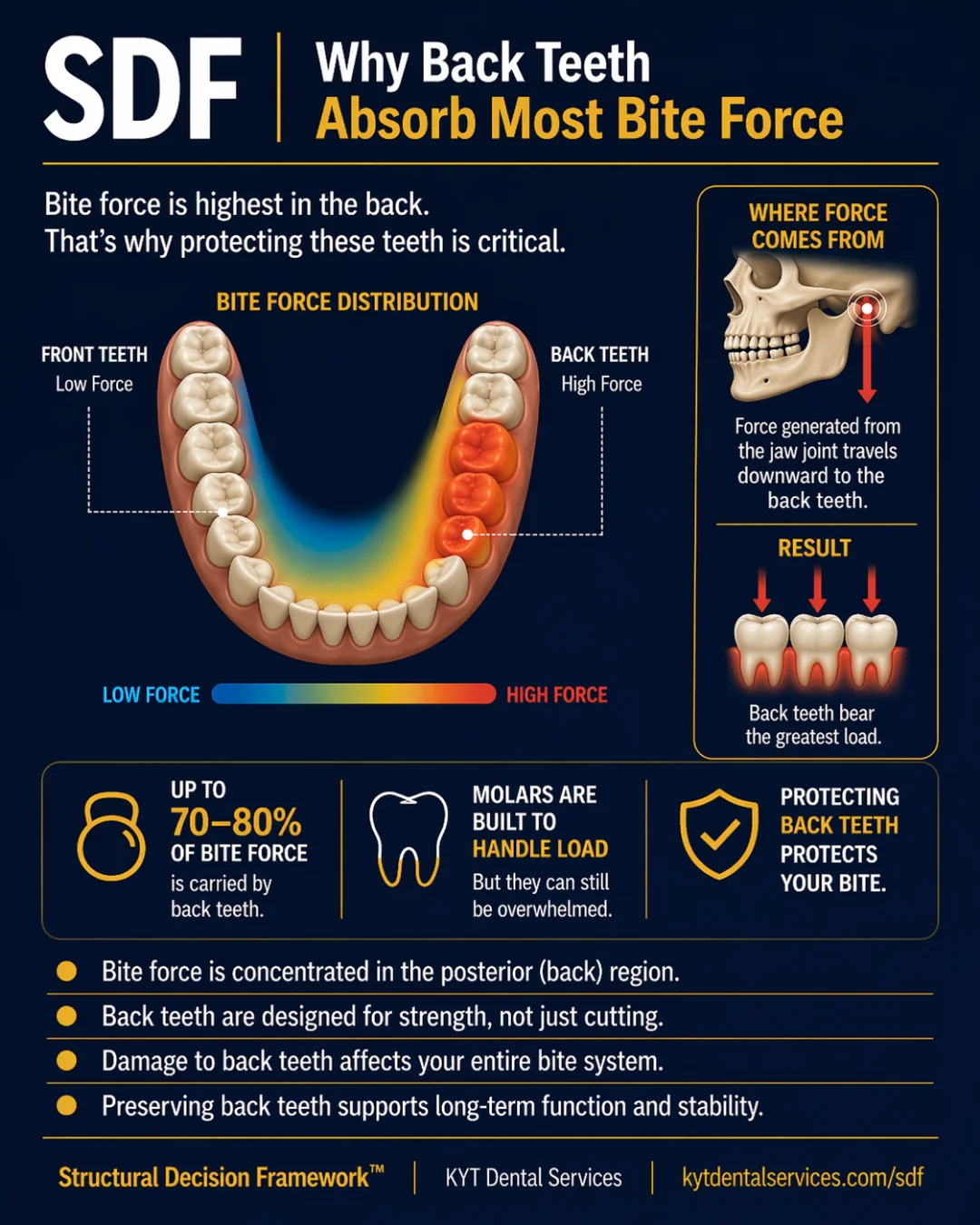
Through the Force lens, the bite isn't a row of equal contributors, it's a lever, and the teeth closer to the pivot carry far more load. Why Back Teeth Absorb Most Bite Force is the card that names the mechanics. Most chewing happens in the back. Most damage happens in the back. The two are connected, and the structural priority follows from there.
Fig. 21 · Why Back Teeth Absorb Most Bite Force
SDF Framework
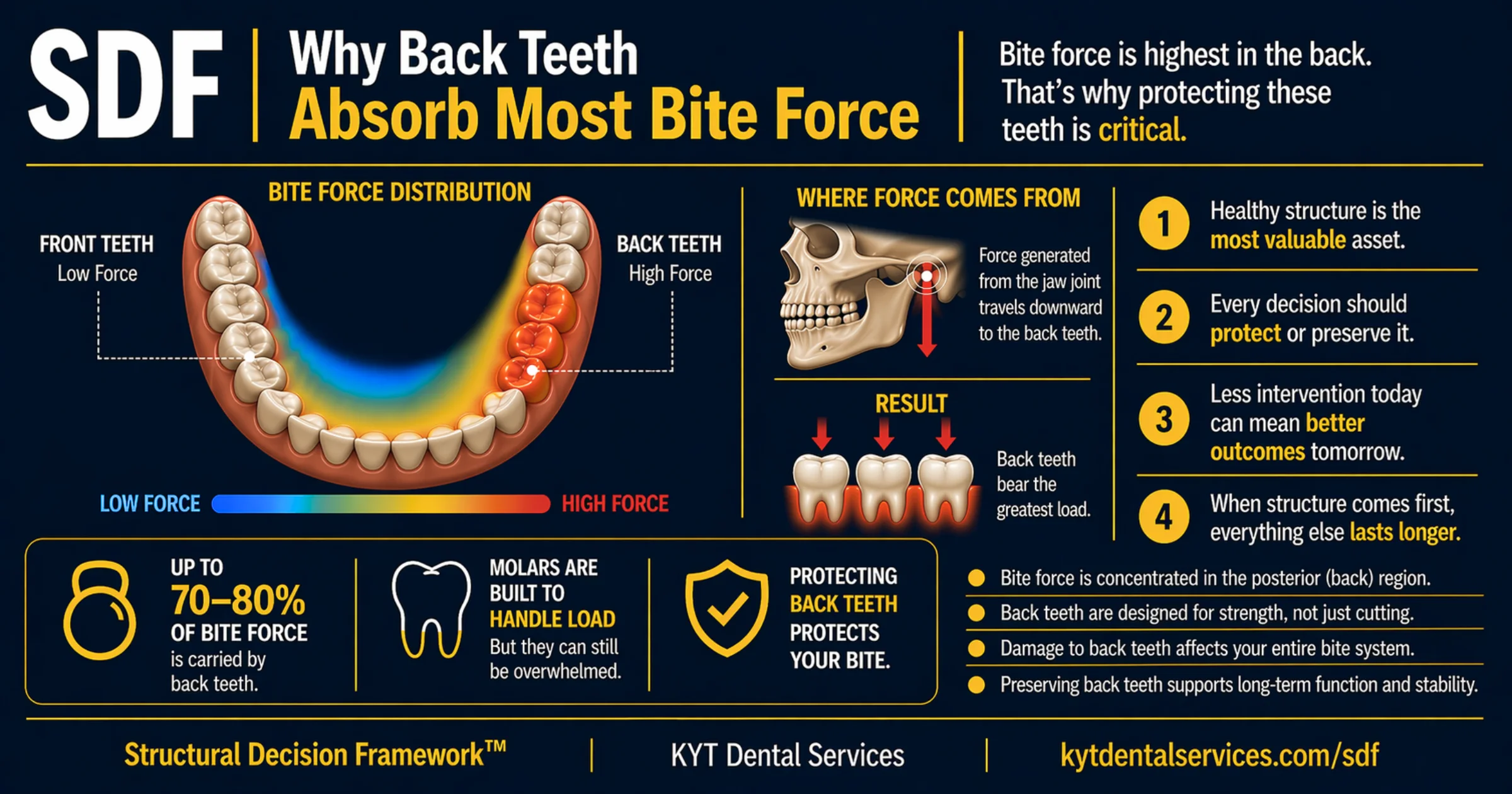
Bite force isn't spread evenly across your teeth. Up to 70-80% of every chew is carried by the back teeth, the molars and premolars. They're closer to the jaw joint, where the lever arm is shortest and the force is highest. That's why molars are shaped the way they are (broad, flat, multi-rooted), and it's also why they're the teeth that wear, crack, and need restoration first. Protecting the back teeth is structural protection for the entire bite.
Explanation
Your jaw is a lever, with the hinge (the temporomandibular joint) at one end and your front teeth at the other. The closer a tooth sits to the hinge, the more force it absorbs from each muscle contraction. The back teeth are right next to the lever's pivot, which is why they carry the lion's share of every bite, typically 70-80% of the total load. That's the mechanical reason molars look the way they do. They're not pointed cutters like the front teeth, they're broader, flatter, with multiple roots digging deeper into the bone. They're built to handle compressive force across a wide surface, repeatedly, for decades. But built to handle force isn't the same as immune to it. Because they take the most load, they're also the teeth where fatigue, wear, and structural problems show up earliest. The first molars are usually the first teeth to need fillings, the first to crack, and the first to fail. When a back tooth is lost or compromised, the rest of the bite has to redistribute force it wasn't designed to carry, and that pressure spreads. Protecting the back teeth isn't about saving one tooth. It's about keeping the load distribution that the entire bite is built around.
Key takeaways
- Back teeth carry up to 70-80% of every bite, far more than front teeth.
- They sit closer to the jaw joint, where the lever arm is shortest and force is highest.
- Molars are built broader, flatter, and multi-rooted because they're designed for compressive load, not cutting.
- Because they take the most force, back teeth wear, crack, and need restoration sooner than front teeth.
- Protecting back teeth protects the load distribution of the entire bite, losing one shifts force to teeth that weren't designed for it.
In the chair
How it shows up.
01
The first molar that failed first
A patient at 45 has all their natural teeth except one, the first lower molar, which was extracted years ago after multiple failed restorations. None of their front teeth have ever needed a filling. The pattern isn't unusual; it's the load distribution doing what physics says it will. The first molars are where the highest force concentrates earliest in life, and they're often the first teeth to show the cumulative cost.
02
The grinder, posterior first
A patient comes in with worn-down cusps on both sides, but only on the back teeth. The front teeth still have their original shape. The bite forces from grinding aren't spread evenly across the arch; they concentrate in the back, where the lever is short and the load is high. Treatment isn't just restoring the worn surfaces, it's reducing the force (nightguard, bite balance) so the same pattern doesn't repeat on the next set of restorations.
03
The cascade after a back tooth is lost
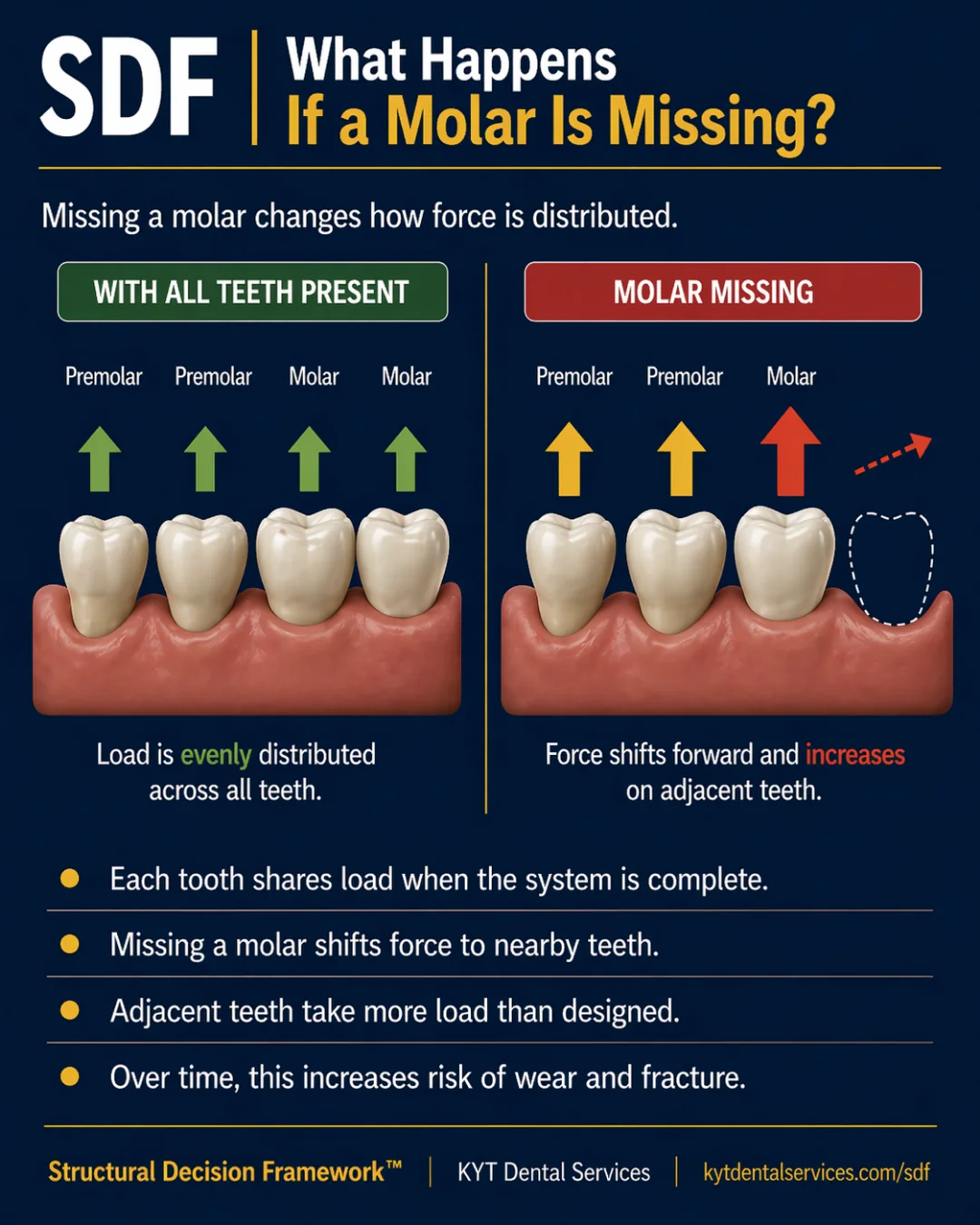
A patient lost a lower second molar at 40 and didn't replace it. Five years later, the first molar in front of it has tipped backward into the space, the upper molar has drifted downward, and the patient's bite has shifted enough that they're now grinding asymmetrically. None of those changes happened in isolation. Losing a high-force tooth without replacing it forced the system to redistribute load to teeth that weren't designed for it.
Through other lenses
The same idea, three other ways.
The whole card is about force distribution. Bite force is a lever, and the back teeth sit at the high-force end of it. Understanding the geometry is what makes everything else about back-tooth wear, fracture, and restoration make sense.
Back teeth need more structure to do their job, broader surfaces, deeper roots, more material. They also lose more structure faster, because they're absorbing more force. The structural budget of a molar is bigger to start with, but it's spent faster too.
The bite is stable when force is distributed across all the teeth designed to carry it. Lose a back tooth or weaken one significantly, and the rest of the bite has to compensate. Stability isn't a property of any single tooth; it's a property of the load distribution across the whole arch.
Common questions
FAQ.
Why do my back teeth absorb so much more force than my front teeth?+
Because of how the jaw is built. Your jaw is a lever, with the joint near your ear acting as the pivot. The closer a tooth is to the pivot, the more force from your jaw muscles concentrates on it. Your back teeth are right next to the pivot; your front teeth are far from it. The result is up to 70-80% of every bite landing on the back.
Why are my molars shaped so differently from my front teeth?+
Because they have a different job. Front teeth (incisors and canines) are pointed and sharp, built for cutting and tearing food, where the force is lower and precision matters. Molars are broad and flat, with multiple roots, because they're built to grind food under high compressive force. The shape follows the function, which follows the force.
Does this mean my back teeth are more likely to have problems?+
Yes, and the data backs it up. The first lower molars are statistically the most-restored teeth in the mouth across most populations. Cracks, wear, large fillings, crowns, root canals, and extractions all show up disproportionately on back teeth. That's not bad luck; it's load doing what load does, given enough time.
How can I protect my back teeth specifically?+
Three things matter most. First, manage forces, a nightguard if you grind, addressing bite issues, avoiding habitual hard chewing on one side. Second, catch problems early on back teeth especially, where the curve from 'small finding' to 'big procedure' tends to move faster because of the load. Third, restore back teeth with longevity in mind, sometimes a crown is a structurally better choice than another large filling, because the next failure on a high-force tooth is usually bigger than the last.
What happens if I lose a back tooth?+
The load it was carrying has to go somewhere. The teeth in front of and opposite the gap absorb extra force, often more than they were designed for. Over time, that shows up as accelerated wear, cracks, or drift in the surrounding teeth. Replacing a missing back tooth (with an implant, bridge, or partial) isn't just about the gap; it's about restoring the load distribution that the rest of the bite is built around.
See this lesson in a real case
Stories behind this lesson.
Patient cases where this idea showed up in the chair.
See it in real teeth
From idea to actual cases.
This site explains the idea. The clinical version, with real cases, real X-rays, and what this looks like in actual mouths, lives at KYT Dental Services, the practice this framework comes from.
See it on KYT Dental Services →Keep going