Structure Comes First
Lesson 20 · Structural Decision Framework
In plain English
We see this all the time: a patient comes in expecting us to drill, and we tell them to wait.
Small spot of decay confined to enamel. No symptoms. Bite is clean. Oral hygiene is good. We could place a filling today, it's quick, it's billable, the patient came in expecting it. Instead we say: "Let's watch it. Come back in six months. If it grows, we'll treat. If it doesn't, we keep what's there."
The patient is sometimes confused. "Aren't you supposed to fix it?"
Sometimes. Not when the cost of fixing is more than the cost of watching.
Here's the principle the whole framework is built on:
Structure comes first. Every dental outcome, strength, stability, treatment longevity, the long-term trajectory of every tooth in your mouth, sits on top of one thing: how much real natural tooth is there to work with.
A great filling on a weak tooth is still a filling on a weak tooth. A simple crown on a strong foundation can last for decades. The procedure is the visible part. The structure underneath is what decides how it holds up.
This is why "protect structure" isn't a posture (aggressive or conservative). It's a question we run on every decision: which option preserves more sound tooth across the next decade? Sometimes the answer is treat now, because waiting would let the problem progress and force a bigger procedure. Sometimes the answer is watch, because treating now would spend structure that didn't need to be spent.
Procedures don't create structure. They preserve it, redistribute force away from it, or replace what's been lost. The structure you have today is the highest amount you'll ever have on a tooth, and the work of dentistry, done well, is to keep that number from dropping faster than it has to.
When we say "let's watch it," we're picking the option that doesn't spend structure today. That's not avoiding care. That's the framework working.
The Lesson
One idea. One lesson.
Every idea in the Structural Decision Framework gets its own lesson. Hover to feel the foil.
SDF-20
StructureStructure Comes First
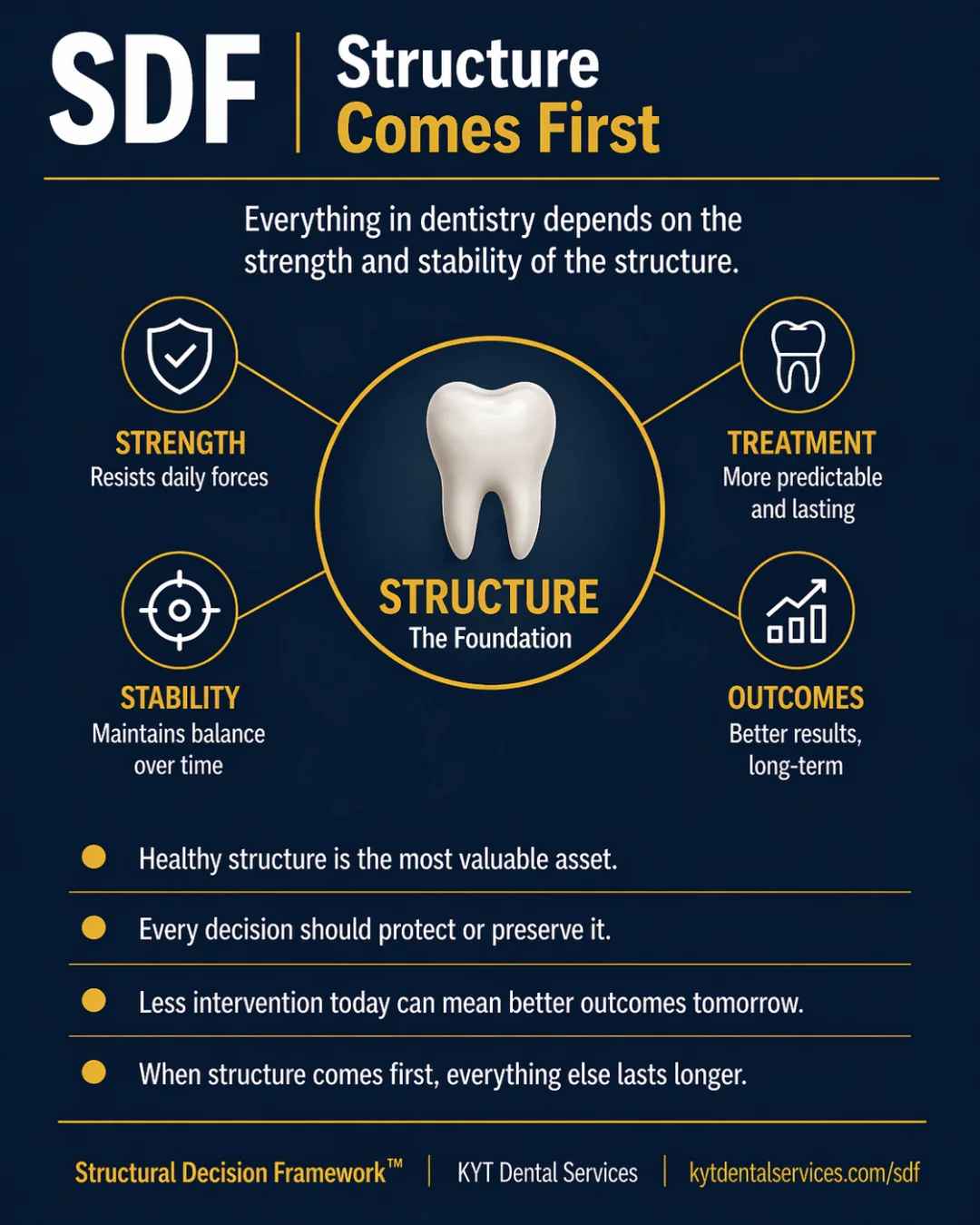
Everything in dentistry, strength, stability, the longevity of every treatment, the outcomes that follow, depends on the structure of the tooth itself. Structure is the foundation. Everything else is built on top of it.
↓ Open the model
Inside the Model
Read the diagram.
Through the Structure lens, every dental decision is a question about what's left and what each treatment costs. Structure Comes First is the card that names the principle the whole framework is built on: protect the foundation, and the rest of dentistry works better. Cut into the foundation unnecessarily, and every other decision downstream gets harder.
Fig. 20 · Structure Comes First
SDF Framework
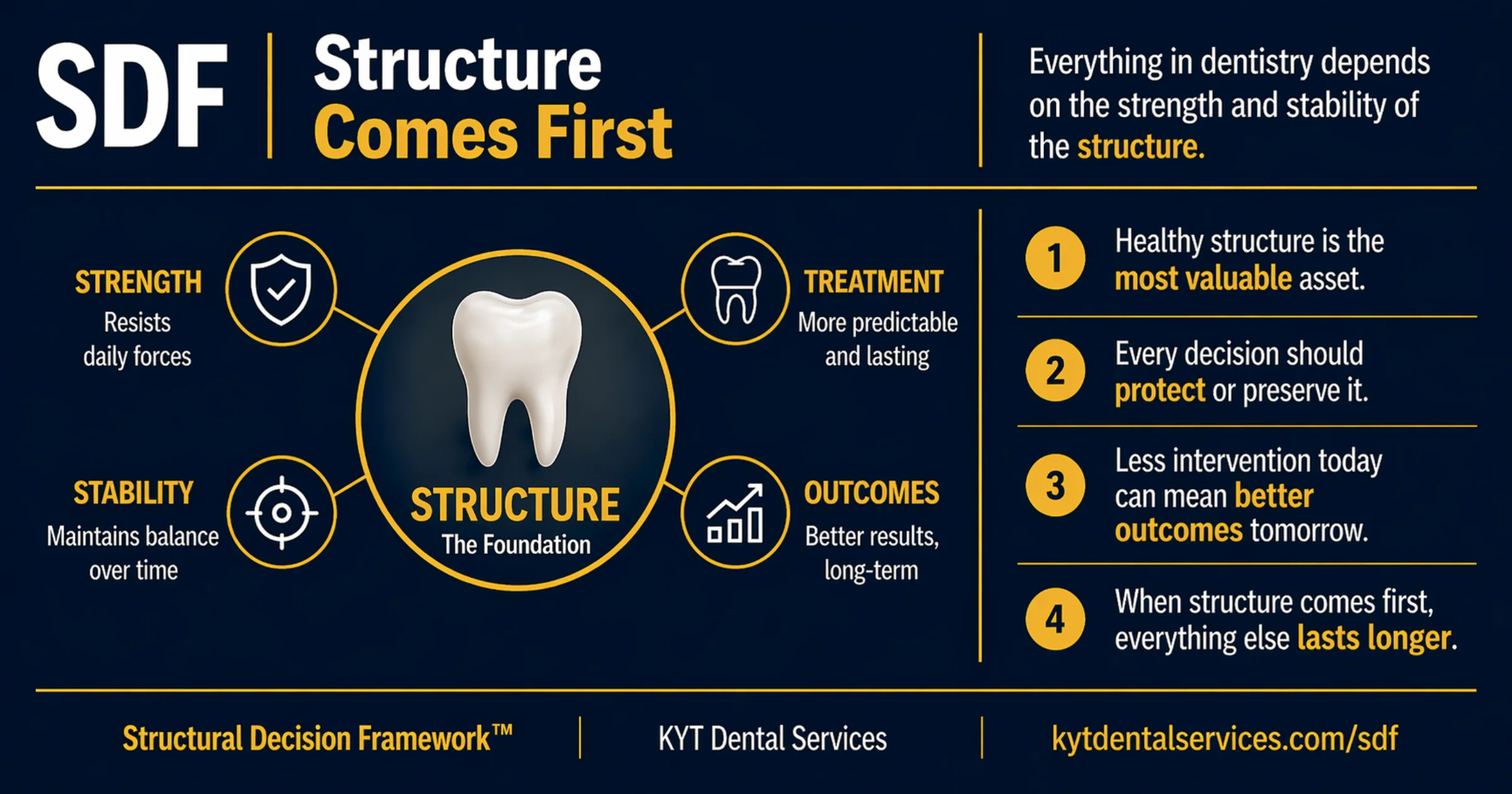
Every dental outcome, how strong a tooth is, how stable it stays, how well a treatment holds up, and how long the result lasts, sits on top of one thing: the structure of the tooth itself. Procedures don't create structure. They work with what's there. That's why the framework starts here. Structure is the foundation that every other variable depends on, and protecting it is the most consistent move in dentistry across the entire life of a tooth.
Explanation
It's easy to think of dentistry as a list of procedures, fillings, crowns, root canals, implants. Each one is real, each one matters. But none of them create structure. They preserve it, redistribute force away from it, or replace what's been lost. The strength a tooth has to resist daily chewing forces is structural. The stability it keeps over years and decades is structural. The longevity of any restoration sits on top of the structure underneath it, a small filling on a strong tooth lasts far longer than a perfect filling on a weakened one. Even outcomes patients care about, how long their teeth feel reliable, whether they need bigger work later, whether the bite stays stable, track the structure underneath. That's why the framework leads with structure. The other lenses (force, time, stability) are how structure changes. Structure itself is the foundation those changes happen to. Protecting it, when possible, is the single most leveraged move in dentistry, because everything else depends on it.
Key takeaways
- Healthy structure is the most valuable asset a tooth has, and the one nothing else replaces.
- Every dental decision should protect or preserve structure when possible.
- Less intervention today often means better outcomes tomorrow, because more structure remains.
- Treatments are more predictable and lasting when the structure underneath them is intact.
- When structure comes first, every other part of dentistry, strength, stability, outcomes, has more room to work.
In the chair
How it shows up.
01
The conservative call
A patient comes in with a small finding on a back molar. The dentist could place a moderate filling now, or watch it for six months. The structural reasoning says: the tooth's strength right now is part of its long-term value. If watching is safe, watching keeps the structure intact for free. The decision isn't 'avoid treatment', it's 'don't spend structure that doesn't need to be spent.'
02
The crown that protected what was left
A patient with an aging large filling has a recommendation for a crown. From a structure-first perspective, the question isn't whether the filling 'still works.' It's whether the remaining tooth around it is strong enough to keep working without protection. A crown placed before the tooth fractures preserves what's there. A crown placed after often means there's less structure to crown over.
03
The bigger picture
A patient is evaluating whether to address a long-standing missing molar. The procedure decision (implant, bridge, leave it) is real. The structural decision underneath is what's happening to the surrounding teeth, are they wearing faster, drifting, or absorbing force they weren't designed for? When structure across the whole mouth is the lens, the question stops being 'do I need this tooth' and becomes 'what's preserving the rest.'
Through other lenses
The same idea, three other ways.
The whole card is structural. Structure is the variable everything else operates on. Strength, stability, treatment longevity, and long-term outcomes all sit on top of how much sound natural tooth structure remains.
Time is what structure has to survive. The longer a tooth is in the mouth, the more cycles, restorations, and forces it absorbs. Putting structure first early is what gives time something to work with, instead of something to chip away at.
Force is what structure has to handle. The same force load on a structurally strong tooth is routine; on a weakened one, it's a stress event. Protecting structure is partly about lowering the force the tooth has to absorb (nightguards, bite balance, restoration design).
Common questions
FAQ.
Why is structure more important than the procedure itself?+
Because every procedure is built on top of the structure that's there. A great filling on a weak tooth is still a filling on a weak tooth. A simple crown on a strong foundation can last for decades. The procedure is the visible part; the foundation underneath is what decides how it holds up.
Doesn't 'protect structure' just mean 'avoid dentistry'?+
No. Sometimes the most structure-preserving move is treating early, because waiting would let the problem progress and force a bigger procedure that costs more structure. 'Protect structure' isn't a posture (aggressive or conservative); it's a question. Each decision is whether this action preserves more structure across the life of the tooth than the alternative.
Can structure be rebuilt?+
Restorations rebuild some of what was lost, a filling fills space, a crown reinforces a weakened tooth, an implant replaces what's gone entirely. But these aren't replacements for natural structure; they're substitutes that work alongside what's left. The natural structure that's gone doesn't come back, which is part of why protecting it matters so much.
How does putting structure first change what gets recommended?+
It changes the question. Instead of 'what procedure fits this finding,' the question becomes 'which path preserves the most structure across the next decade.' Sometimes that's monitoring. Sometimes that's restoring early. Sometimes that's a crown rather than another filling. The recommendation isn't a default, it's whichever option keeps the foundation strongest going forward.
What's the most useful thing I can do as a patient?+
Two things. First, treat your remaining structure as the asset it is, regular checkups, addressing forces (grinding, bite issues), and acting while findings are still small are all ways of protecting it. Second, when you're weighing a treatment recommendation, ask the structural question: which option leaves more sound tooth in five and ten years? That's the thread the whole framework follows.
See this lesson in a real case
Stories behind this lesson.
Patient cases where this idea showed up in the chair.
See it in real teeth
From idea to actual cases.
This site explains the idea. The clinical version, with real cases, real X-rays, and what this looks like in actual mouths, lives at KYT Dental Services, the practice this framework comes from.
See it on KYT Dental Services →Keep going