Why Redo Dentistry Increases Risk
Lesson 17 · Structural Decision Framework
In plain English
We see this all the time: a 60-year-old patient with a tooth that's been treated four times across the last 35 years.
Small filling at 25. Larger replacement filling at 35. Crown at 50, after the filling broke. Root canal at 60, when the crown leaked and decay reached the nerve. Each step was the right call at the time. Each step also removed more structure than the one before it.
The endpoint wasn't a single bad decision. It was the redo cycle running on one tooth for thirty-five years.
Here's the part most patients don't realize:
Every dental procedure has a structural cost, and redos cost more than the original.
The first filling on a healthy tooth removes a small amount of structure. When it eventually wears out, the replacement has to clear the old material plus a margin of surrounding tooth to give the new restoration something clean to bond to. The new restoration ends up larger than the previous one. By the third or fourth cycle on the same tooth, what started as a small filling has often become a crown, a root canal, or both.
This isn't an argument against doing dentistry when it's needed. It's the reason for making each treatment count.
Three things lower the number of cycles a tooth has to run across a lifetime:
1. Catch problems early. A tooth treated at 5% structural loss costs 5%. The same tooth caught at 25% costs 25%, five times more, to address.
2. Make each restoration durable. This is partly the dentist (technique, materials) and partly the patient (forces, grinding shortens restoration lifespan dramatically).
3. Choose for longevity. Sometimes the smaller current procedure is the one that fails first. A crown that costs more today but stops a redo cycle is structurally cheaper than two more fillings over twenty years.
The best way to keep a tooth long-term is to do as little to it as possible, as well as possible, the first time. The redo cycle never starts on the teeth where the first restoration just keeps working.
The Lesson
One idea. One lesson.
Every idea in the Structural Decision Framework gets its own lesson. Hover to feel the foil.
SDF-17
StructureWhy Redo Dentistry Increases Risk
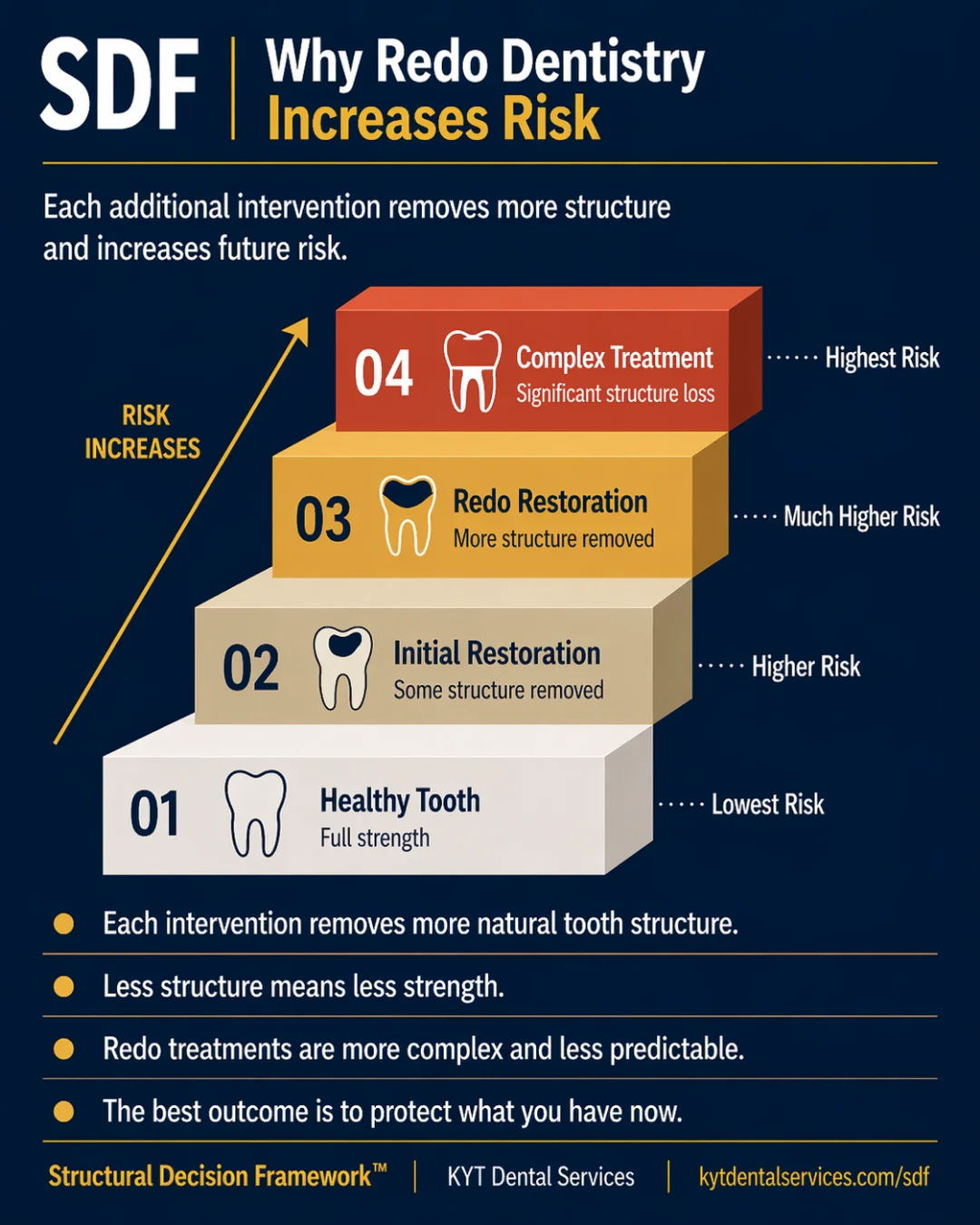
Every redo costs more structure than the one before it. The repair cycle is what turns a small filling, slowly, into a root canal and a crown.
↓ Open the model
Inside the Model
Read the diagram.
Through the Structure lens, the redo cycle is the most common path a tooth takes from healthy to lost, and it's almost entirely about how much natural structure each cycle removes. Why Redo Dentistry Increases Risk is the card that names the math: every additional intervention costs more than the last, and the cumulative cost is what drives the long-term outcome.
Fig. 17 · Why Redo Dentistry Increases Risk
SDF Framework
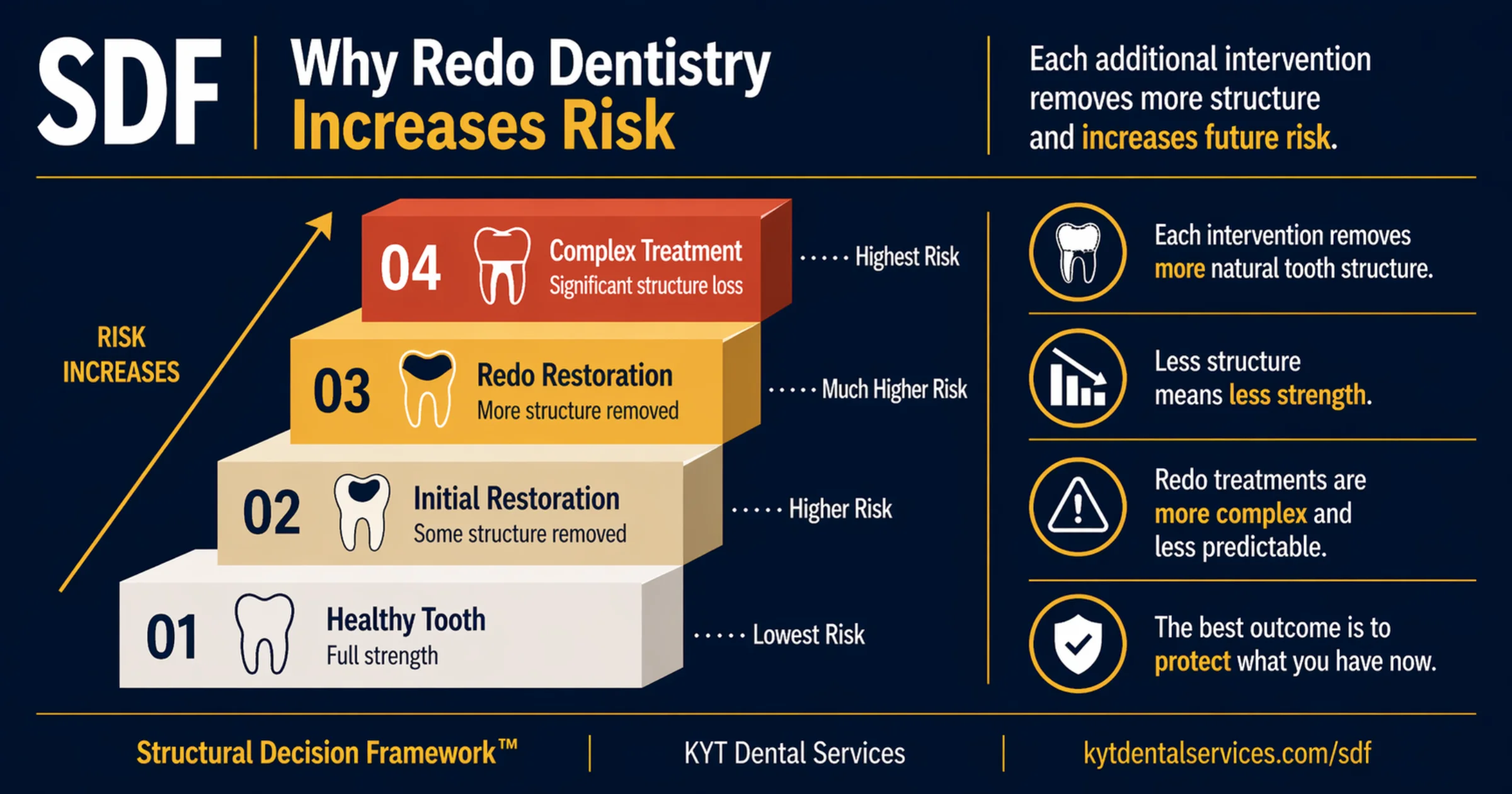
Every dental procedure has a structural cost, and a redo always costs more than the original. The first filling on a healthy tooth takes a small amount of structure. The second restoration on the same tooth has to remove the old material plus shape new room, so it takes more. By the third or fourth cycle, the tooth has lost enough structure that bigger procedures (crowns, root canals) become necessary. The redo cycle isn't a sequence of random failures, it's the predictable arithmetic of repeated interventions on the same tooth.
Explanation
When a tooth is healthy, it's at its strongest. The first restoration, a filling, an inlay, a small crown, removes some structure but the tooth still has most of its original material doing structural work. When that restoration eventually wears out (and most do, eventually), the next dentist has to remove what's left of the old restoration plus a margin of the surrounding tooth to make room for fresh material. The new restoration is bigger than the last one. The remaining tooth is smaller. Run this cycle a few times, across decades, often with different dentists, and what started as a small filling on a healthy tooth gradually becomes a large filling, then a crown, then a root canal, sometimes an extraction. The progression isn't bad luck. It's structural math. The best way to protect a tooth long-term isn't to avoid dentistry when it's needed; it's to make each treatment count, so fewer cycles run on the same tooth across a lifetime.
Key takeaways
- Each restoration removes more natural tooth structure than the one before it.
- Less structure means less strength, and less buffer against the next problem.
- Redo treatments are more complex and less predictable than the original.
- The progression from small filling to crown to root canal isn't random, it's the redo cycle running its course.
- The best outcome is to protect what you have now and make each treatment as durable as possible.
In the chair
How it shows up.
01
The classic three-decade slide
A small filling at age 25. A larger replacement filling at 35. A crown at 50, after the filling broke. A root canal at 60, when the crown leaked and decay reached the nerve. Each step was the right call at the time, but each step also removed more structure than the one before it. The endpoint wasn't a single bad decision; it was the cycle running on a single tooth for thirty-five years.
02
The first restoration that lasted
A patient had a filling placed at age 30 and never had it touched again. At 70, it's still there, still doing its job, on a tooth that's otherwise unrestored. The reason the tooth is still strong isn't that nothing was done, it's that one well-placed first restoration didn't need to be redone. The redo cycle never started.
03
The decision to crown, not refill
A patient comes in with a failing large filling on a back molar, the third time it's been replaced. The dentist suggests a crown instead of another filling. The structural math behind the recommendation: another filling will likely need to be redone in 5–10 years, and each redo removes more structure. Crowning now stops the cycle. It costs more today to save more tooth across the next thirty years.
Through other lenses
The same idea, three other ways.
The whole card is structural. Each redo subtracts material that doesn't come back. Across enough cycles, even small per-procedure losses add up to a tooth that no longer has the structure to do the work it was designed to do.
Time is what makes the redo cycle visible. Any single restoration looks fine at five years. The cycle becomes obvious at twenty or thirty, when the same tooth has been treated three or four times. Long-term thinking is what makes the math land.
Stability after a restoration depends on how much natural structure is left around it. Each redo erodes that base. The teeth that stay stable longest are usually the ones with the fewest cycles run on them, not necessarily the ones with the best individual restorations.
Common questions
FAQ.
Why does a redo remove more structure than the first restoration?+
Because the dentist has to clear out the old material plus a margin of the surrounding tooth to give the new restoration something clean to bond to. There's also usually some recurrent decay around the old margins that has to be removed. The new restoration ends up larger than the previous one, that's how each cycle compounds.
Does this mean fillings should be avoided?+
No, when a tooth needs a filling, a filling is the right call. The point isn't to avoid the first cycle; it's to avoid running the cycle four times on the same tooth across a lifetime. That's a combination of catching things early enough that the first restoration is small, doing each restoration well so it lasts, and reducing the forces (grinding, bite issues) that shorten restoration lifespan.
How long should a filling or crown last?+
Fillings: roughly 7–15 years on average, depending on size, location, and bite forces. Crowns: 10–25 years, sometimes longer. Both depend more on the patient's habits and forces than on the dentist alone. The longer each restoration lasts, the fewer cycles run on the tooth, which is why protecting your bite (nightguards if you grind, addressing crowding) is part of long-term tooth preservation.
Is sometimes 'doing more' actually 'doing less' in the long run?+
Yes, that's part of why crowns are sometimes recommended over yet another filling. A crown takes more structure today than a filling, but if it stops a redo cycle that would otherwise run two more times, the lifetime structural cost is lower. The right call depends on where the tooth is on its curve, not just on which procedure is smaller in the moment.
What's the most important thing I can do to avoid the redo cycle?+
Three things, roughly in order of leverage. First, don't skip checkups, early detection keeps first restorations small. Second, manage forces (grinding, clenching, hard chewing habits) because force is what shortens restoration lifespan. Third, when treatment is needed, choose for longevity rather than for the smallest current procedure if those two are in tension. Each one of these reduces the number of cycles a given tooth has to run.
See this lesson in a real case
Stories behind this lesson.
Patient cases where this idea showed up in the chair.
See it in real teeth
From idea to actual cases.
This site explains the idea. The clinical version, with real cases, real X-rays, and what this looks like in actual mouths, lives at KYT Dental Services, the practice this framework comes from.
See it on KYT Dental Services →Keep going