Monitoring vs Treating: When Waiting Is Safe
Lesson 14 · Structural Decision Framework
In plain English
We see this all the time: a patient comes in for a cleaning and we point at a small spot on an X-ray. "It's a tiny bit of decay in the enamel. We're going to watch it, not treat it."
The patient looks confused. "Don't you want to fix it before it gets worse?"
Sometimes. Not always.
This is the part most patients don't realize:
Not every dental finding needs treatment that day. Some need watching, and the trick is knowing when watching stops being safe.
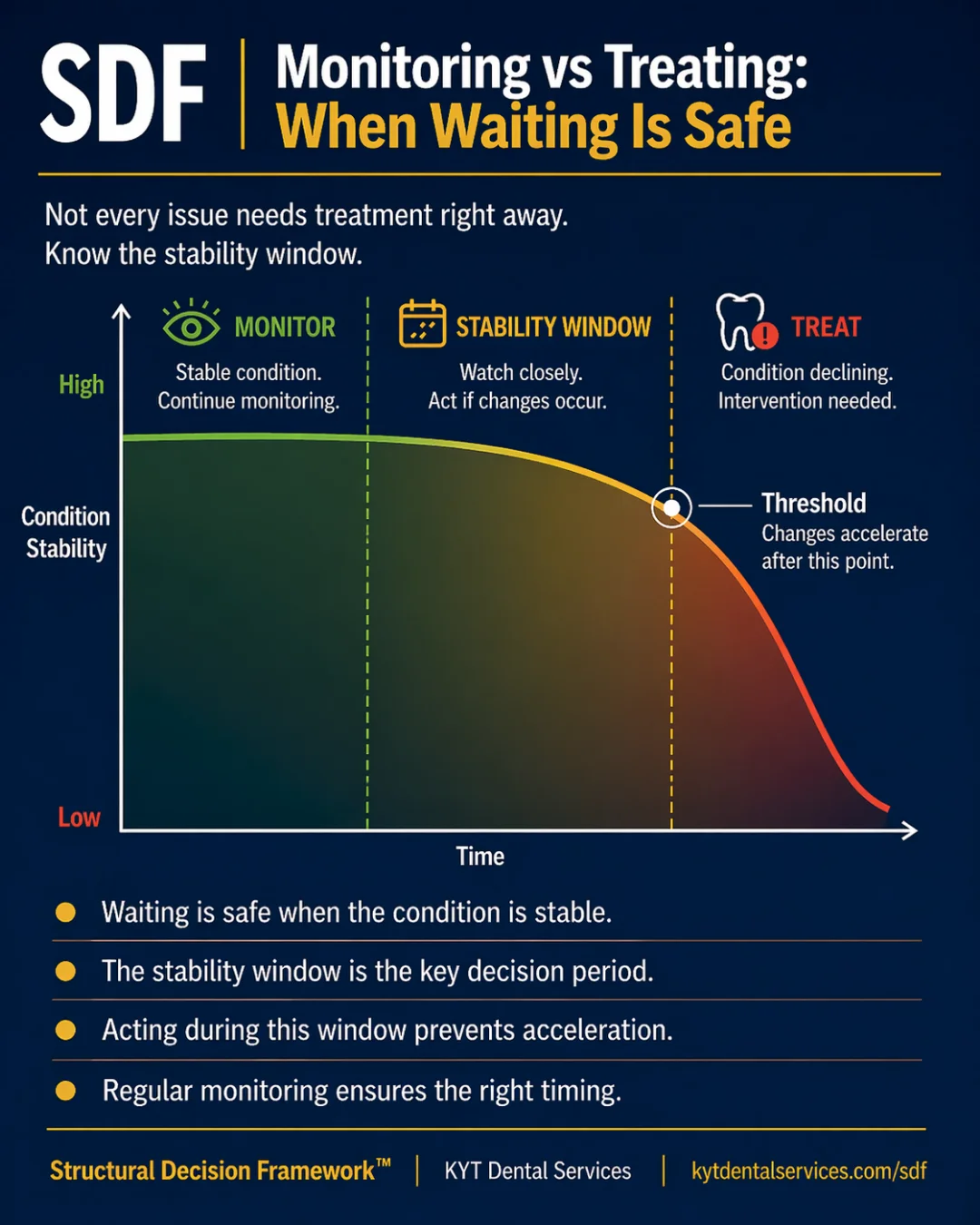
Every dental finding sits on a curve. There are three zones:
1. Stable zone: the finding isn't growing. It's been the same size for years. Treating it would mean drilling out healthy tooth structure to fix something that's not actually progressing. The cost of action exceeds the cost of waiting.
2. Stability window: the finding could go either way. It might stay stable. It might start to decline. The right move is close monitoring, usually shorter checkup intervals, maybe a photo or measurement at each visit so changes are caught early.
3. Past the threshold: the finding has crossed into active progression. Waiting only makes the eventual treatment bigger. Acting now is the lower-cost path.
"Watch and wait" isn't dental procrastination. It's a real clinical decision, when the condition is stable. The point isn't to avoid treatment. It's to time it right.
The risk in both directions:
• Treating a stable finding too early costs you healthy structure that didn't need to go.
• Waiting on a finding that's already past the threshold costs you more structure than necessary.
The right time is in the middle, when the finding is starting to move but hasn't crossed into active damage yet. Reading where on the curve a tooth is, that's the whole skill.
When a dentist says "let's watch this," what they mean is "this is in the stable zone, let's not spend structure we don't need to spend." When the same dentist comes back a year later and says "now's the time," they've read the curve turning.
The Lesson
One idea. One lesson.
Every idea in the Structural Decision Framework gets its own lesson. Hover to feel the foil.
SDF-14
TimeMonitoring vs Treating: When Waiting Is Safe
Not every issue needs treatment right away. Some need watching, and the trick is knowing when watching stops being enough.
↓ Open the model
Inside the Model
Read the diagram.
Through the Time lens, every dental finding has a trajectory, and the trajectory has zones. Monitoring vs Treating is the card that names them. The stable zone says 'don't act yet.' The stability window says 'act soon if anything changes.' The threshold says 'act now.' Reading which zone a finding sits in is how a clinician times intervention well.
Fig. 14 · Monitoring vs Treating: When Waiting Is Safe
SDF Framework
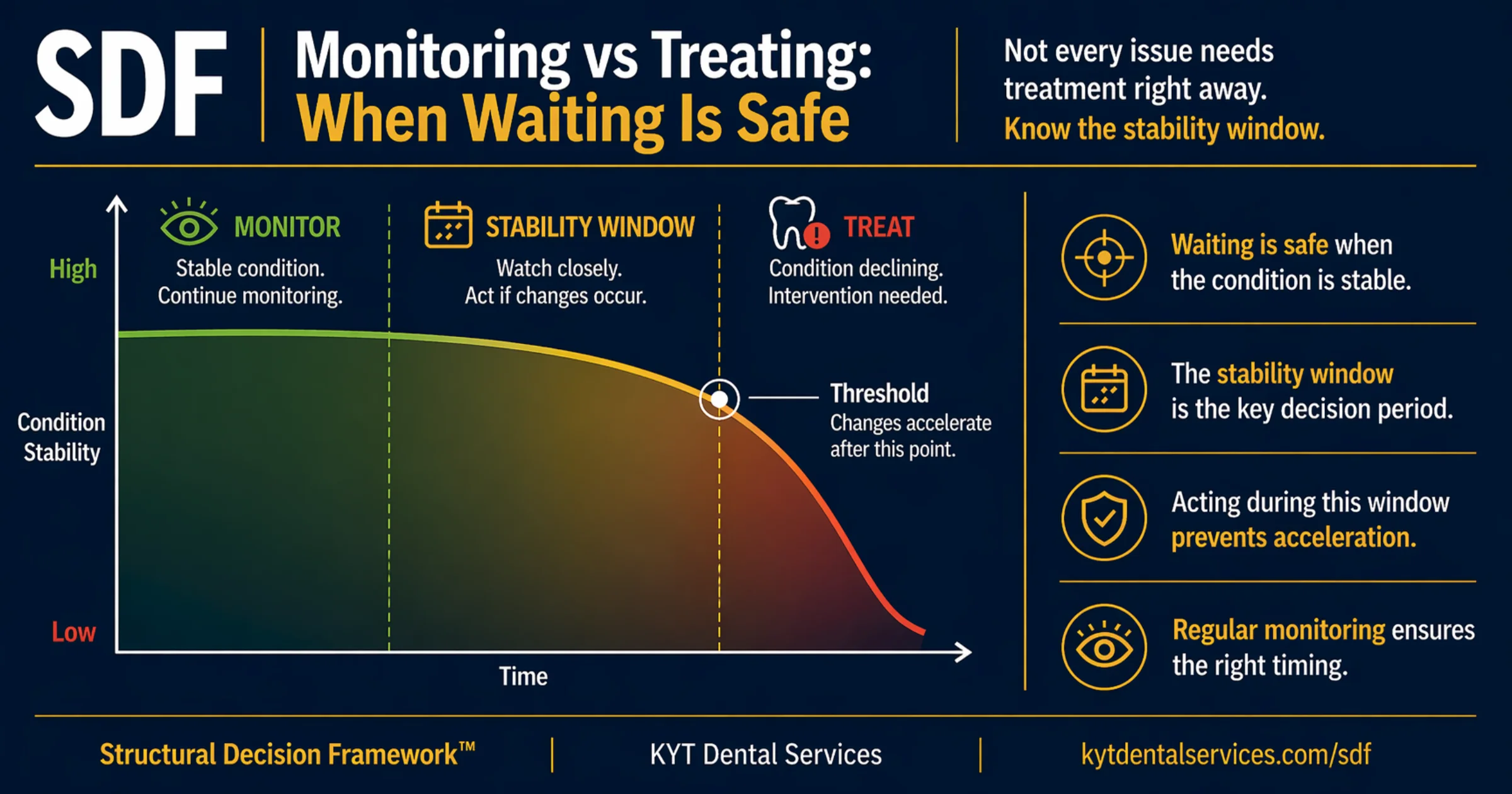
Not everything that gets noticed at a checkup needs treatment that day. Some findings are stable, the right move is to monitor. Some are in a stability window where things could go either way, they need to be watched closely. Some have crossed a threshold where waiting only makes treatment harder. Knowing which zone something is in is the whole skill of timing a treatment decision well.
Explanation
There's a curve every dental finding sits on, high stability at the start, gradually declining, then accelerating downward past a threshold. While a finding is in the stable zone, doing nothing is often the right call. The structure isn't being lost, the symptoms aren't growing, and treating it would mean removing healthy tissue for no real gain. In the stability window, the finding could go either way. Maybe it stays stable. Maybe it starts to decline. The right move is close monitoring, usually shorter checkup intervals, sometimes a photo or measurement at each visit so changes are caught early. Past the threshold, the line drops faster than expected. Acting in the window keeps things from getting to that point. Acting after it usually means more aggressive treatment than would have been needed earlier. 'Watch and wait' isn't dental procrastination. It's a real clinical decision. The point isn't to avoid treatment, it's to time it right.
Key takeaways
- Waiting is safe when the condition is stable, and overtreating a stable tooth costs structure for no benefit.
- The stability window is the key decision period, close monitoring catches change while the response is still small.
- Acting during the stability window prevents the acceleration that comes after the threshold.
- Once the threshold is crossed, deterioration speeds up, and treatment usually has to be more aggressive.
- Regular monitoring is what makes the right timing possible. You can't catch a window you're not watching.
In the chair
How it shows up.
01
The watched cavity that didn't grow
A small spot of decay shows up on an X-ray. It's confined to enamel, the patient brushes well, and there's no sign of progression. The dentist marks it and watches it for two years across four checkups. It hasn't grown. Treating it would have cost more tooth than the cavity itself. Monitoring was the right call, and it stayed right because it was actually monitored.
02
The change caught in the window
A crack line in a back molar that's been stable for years. At one checkup, the patient mentions chewing sensitivity that wasn't there before. The crack hasn't visibly grown, but the symptom is the signal. The dentist places a crown before the crack progresses to the nerve. The window closed; acting in it kept the tooth from needing a root canal.
03
The threshold that got missed
A patient skipped checkups for three years and came back when chewing on one side started hurting. The X-ray showed the same finding from years ago, but now it's deep into the pulp. What was a 'monitor' finding became a 'treat now' finding, and the treatment is bigger than it would have been at the right time. Time, when not watched, is the variable that runs out.
Through other lenses
The same idea, three other ways.
Time is what decides which zone a finding is in. The same finding can be 'monitor' today and 'treat' two years from now, not because the finding got worse on its own, but because time accumulates. Regular checkups are how time stays a tracked variable instead of an unknown.
Treating a stable finding too early costs healthy structure. Waiting too long costs more structure than necessary. The stability window exists precisely to keep structure preserved, by acting at the right time, not the earliest or latest possible time.
The whole curve is a stability curve. Stable findings stay stable until something tips them. The stability window is the warning band before the threshold. Once stability is lost, the speed of further loss usually surprises people who weren't watching closely.
Common questions
FAQ.
Why doesn't my dentist treat everything they find?+
Because treating a stable finding costs healthy tooth structure for no benefit. If a small spot of decay isn't growing, drilling it out removes more tooth than the decay itself. The right approach is to track it, and treat it only if (and when) it starts to change.
How do I know if 'watch and wait' is the right call or my dentist is missing something?+
A real watch-and-wait plan has specifics. Your dentist should be able to tell you what they're watching, what would change the plan (size, depth, symptoms), and how often they'll check it. If 'we'll keep an eye on it' is vague and there's no recheck schedule, that's worth pushing on. Monitoring requires actually monitoring.
What's the 'stability window'?+
It's the zone between fully stable and clearly past the point of no return. In this window, the finding could stay stable or start to decline. Catching the decline early, usually through more frequent checkups, photos, or measurements, is how you avoid letting it cross the threshold. Most preventive dental care is actually about working in this window.
What happens if I cross the threshold?+
Things tend to move faster than expected past the threshold. A finding that took years to develop can progress significantly in months once it's destabilized. The treatment that would have been a small repair often becomes a crown or a root canal. The threshold isn't a cliff, but it's where the curve gets steep.
Can I just skip checkups and come in when something hurts?+
You can, but that's the path that almost always lands in the 'past the threshold' zone, because most early changes are silent. Pain is usually a late signal in dentistry. The reason regular checkups matter isn't to find more things to treat; it's to catch things while monitoring is still the right call.
See this lesson in a real case
The story behind this lesson.
A patient case where this idea showed up in the chair.
See it in real teeth
From idea to actual cases.
This site explains the idea. The clinical version, with real cases, real X-rays, and what this looks like in actual mouths, lives at KYT Dental Services, the practice this framework comes from.
See it on KYT Dental Services →Keep going